
For disaster restoration companies, removing soot quickly and efficiently is essential to returning properties to a habitable condition. Traditional cleaning methods can be labour-intensive, messy and time-consuming, often requiring large amounts of manual scrubbing or abrasive blasting.
At Pure Lasers, we've found soot removal to be one of the most effective and rewarding applications for laser cleaning. The speed, precision and cleanliness of the process make it an ideal solution for restoration professionals looking to improve productivity and reduce operating costs.
Fire damage restoration presents several unique challenges. Soot can penetrate intricate architectural features, textured surfaces and hard-to-reach areas, making it difficult to remove completely using conventional methods.
Traditional restoration techniques often involve:
As restoration companies take on larger and more complex projects, reducing cleaning time while maintaining high-quality results becomes increasingly important.
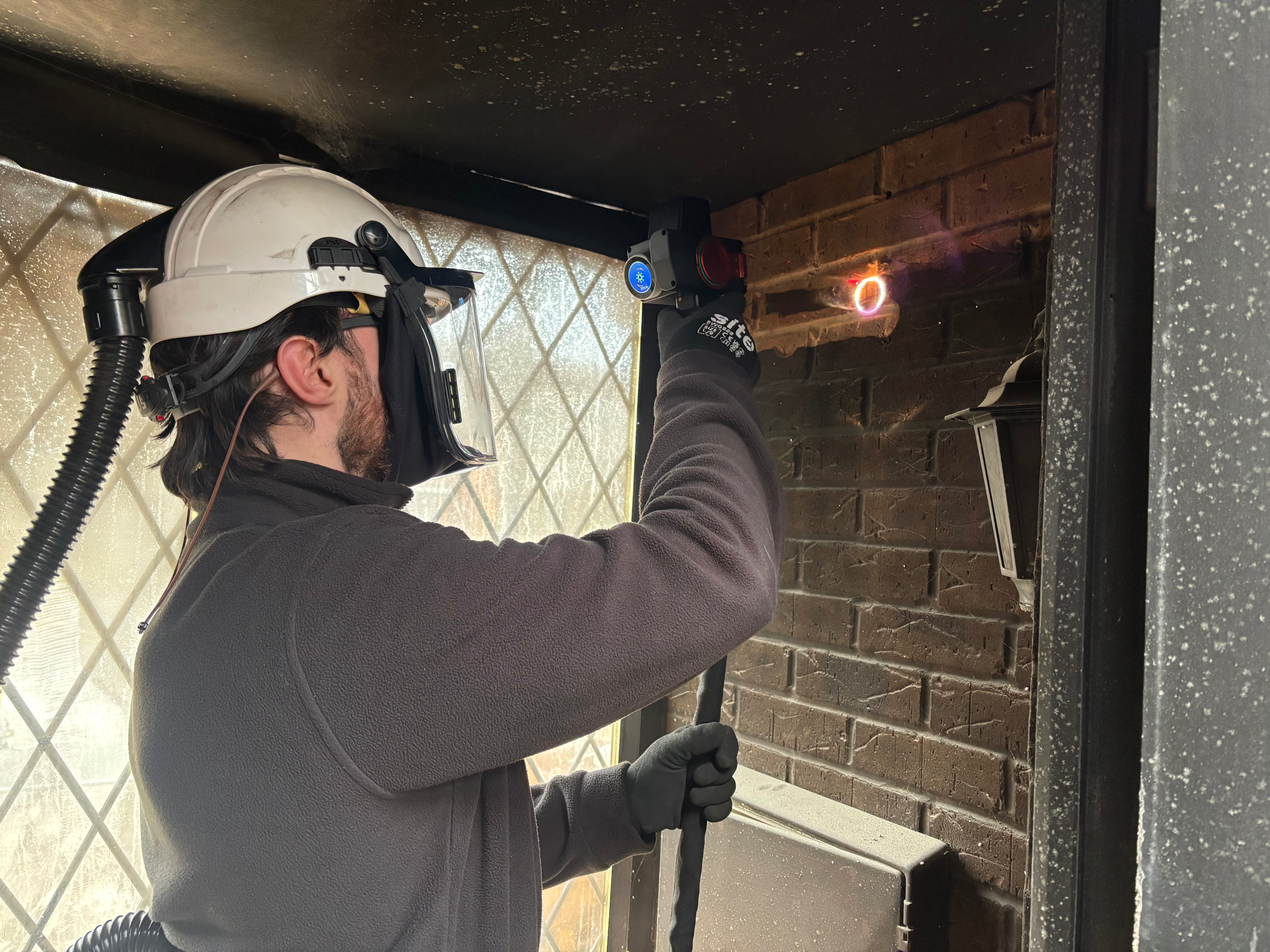
Pure Lasers introduced portable pulsed laser cleaning technology to remove soot directly from fire-damaged surfaces without the need for chemicals or abrasive media.
Because soot is a thin, carbon-rich contaminant, it absorbs laser energy extremely efficiently. This allows the laser to remove contamination quickly while leaving the underlying substrate largely unaffected when the correct parameters are used.
The portability of our laser cleaning systems also allows operators to work efficiently inside buildings, around scaffolding and in confined spaces without transporting heavy blasting equipment or large compressors.
For restoration contractors, this means faster setup, cleaner working environments and greater flexibility across a wide variety of projects.
Laser cleaning has become one of our preferred methods for soot removal, delivering outstanding results across a range of fire restoration projects.
Key benefits include:
Several disaster restoration companies now use our laser cleaning machines as a core part of their restoration process, describing the technology as a "game-changing" addition to their business. By reducing labour, simplifying logistics and delivering consistently high-quality results, laser cleaning has helped them complete projects more efficiently while providing a premium service to their clients.
If you're a fire or disaster restoration company looking to reduce labour, eliminate abrasive media and complete projects more efficiently, we'd be happy to demonstrate how laser cleaning can fit into your restoration workflow. Contact Pure Lasers to arrange a live demonstration or discuss your requirements.